Homemade Cream Cheese
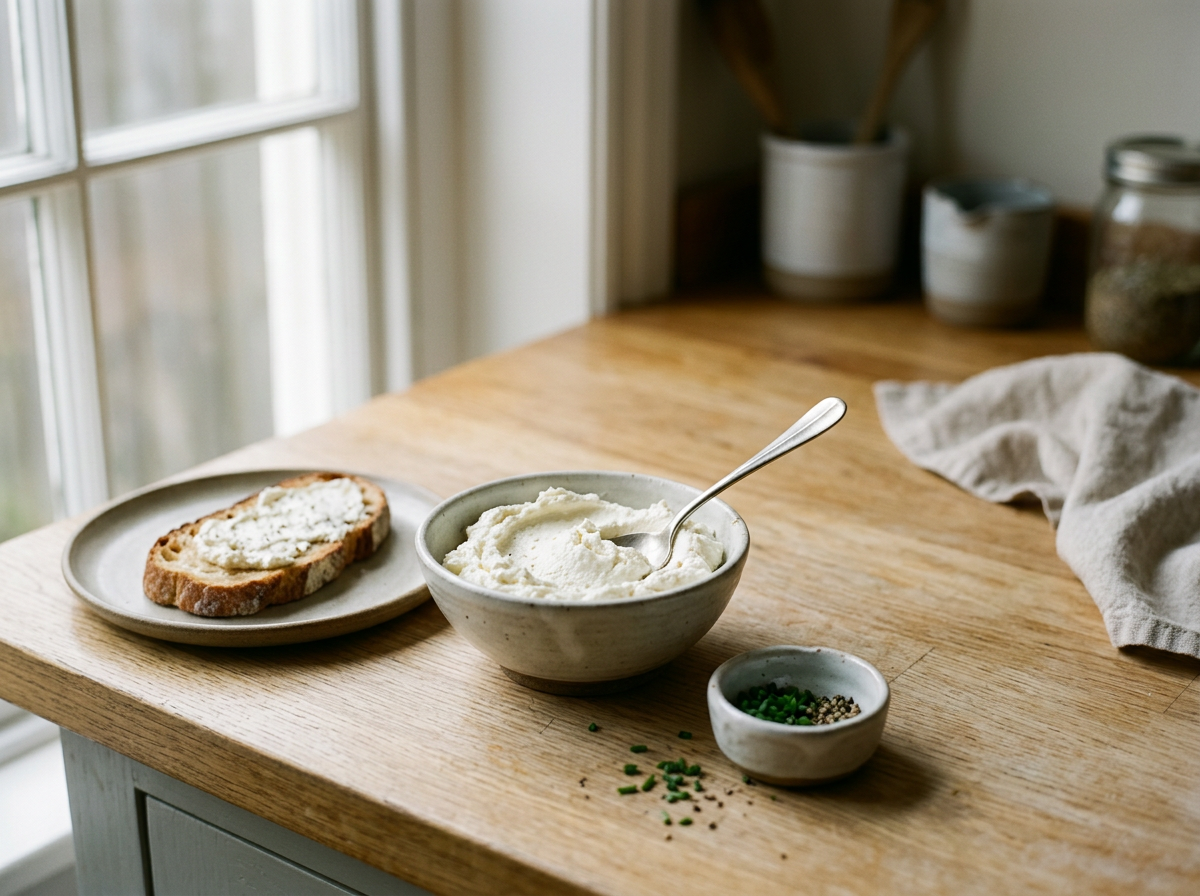
I started making cream cheese for the worst possible reason: I ran out on a Sunday morning with bagels already toasting. What I found online was a five-minute version involving lemon juice, and what I got was perfectly nice, and also not cream cheese. It was warm ricotta with ambitions. Pleasant on the bagel, gone by Tuesday, and missing the thing that makes cream cheese cream cheese — that clean sour tang that comes from bacteria doing slow work overnight, not from acid dumped into hot milk.
So this is the slow version. It takes two days, but the active time is about fifteen minutes spread across them, and the result is genuinely better than anything in a foil-wrapped block: looser, tangier, tasting of actual cream.
What you need
1 litre whole milk (3.5% fat or higher)
500 ml double cream (35–40% fat)
60 ml cultured buttermilk, with live active cultures
2 drops liquid rennet, diluted in 15 ml cool water — optional
5 g fine sea salt
Plus a large piece of muslin or a clean thin tea towel, a sieve, and a bowl.
One rule that matters more than everything else: the milk cannot be UHT or ultra-pasteurised. The high heat denatures the proteins so badly that they will not form a proper curd, and you will get soup. Check the carton — "pasteurised" is what you want, "ultra-pasteurised" or "UHT" is what you don't. Cream is the harder one to source, because most supermarket double cream is UHT. If you can only find UHT cream, use 1.5 litres of good pasteurised whole milk instead and accept a slightly leaner cheese. It's still excellent.
Day one: culture it
Warm the milk and cream together in a saucepan to 22°C. That's barely warm — room temperature on a summer day. You are not cooking anything here; you're just making sure it isn't fridge-cold. If you overshoot above 40°C, let it cool back down, because heat above that kills the cultures you're about to add.
Stir in the buttermilk, then the diluted rennet if you're using it. Stir gently for about 30 seconds, top to bottom, then stop. The rennet is optional but I recommend it — it gives you a firmer curd that drains cleanly instead of sludging through the cloth.
Cover and leave it alone somewhere around 20–24°C for 12 to 18 hours. An oven with the light on works well in a cold kitchen. Don't stir it, don't check it, don't move the pot.
In the morning it should be set — wobbly and thick like a loose yogurt, with a thin layer of clear yellowish whey on top and perhaps a crack or two across the surface. Tilt the pot; the mass should move as one piece rather than sloshing. If it's still liquid, give it another 4 hours. If it's still liquid after that, the milk was almost certainly ultra-pasteurised.
Day two: drain and salt
Line your sieve with damp muslin, set it over a bowl, and ladle the curd in gently. Don't pour it in one go — you'll break the curd and lose solids through the cloth.
Gather the corners and tie them, then let it drain in the fridge for 6 to 12 hours. Six gives you something spreadable and soft; twelve gives you something firm enough to slice. I aim for about eight. Don't squeeze it, which pushes fat out along with the whey and leaves the texture chalky.
Weigh the drained curd and salt it at 1% — so 4.5 g of salt for 450 g of cheese. Salt by weight rather than by spoon here, because cream cheese is bland and forgiving right up until it's too salty, and there's no coming back.
Then whip it. This is the step that turns homemade cheese into something that looks shop-bought. Beat the curd in a food processor, or with a hand whisk, for 60 to 90 seconds until it's completely smooth and glossy. If it's stiffer than you want, whisk in whey a teaspoon at a time — it loosens without diluting the flavour.
Notes
Keep the whey. You'll have close to a litre of it, and it's mildly acidic and full of protein. Use it in place of water in bread dough, in pancake batter, or in a smoothie. It keeps a week in the fridge.
Flavour it after salting, never before: finely chopped chives and cracked black pepper, grated garlic and dill, lemon zest, or — my favourite — 15 g of honey and a good pinch of flaky salt.
It keeps 10 days in a sealed container in the fridge. It will firm up as it sits and may weep a little whey; stir it back in. Don't freeze it, because the texture breaks and never fully recovers.
If the flavour is flat, your culture ran short. Next time push the incubation to 18 hours, or switch from buttermilk to a mesophilic starter culture, which gives a sharper, more distinctly cheesy tang.
The bagel test is the real one. Make it on a Friday, eat it Sunday morning, and you'll understand why the block version tastes like packaging.